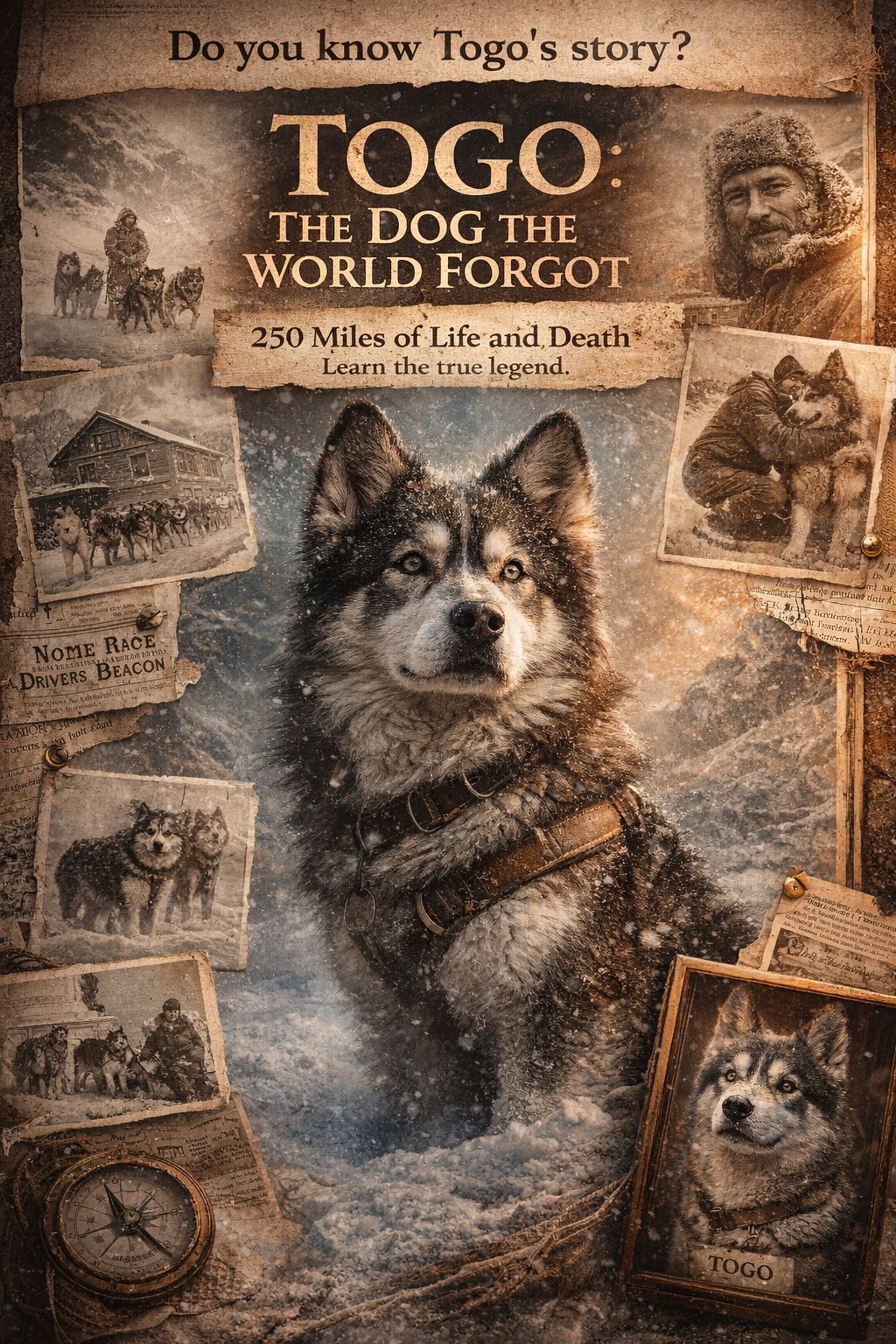
The Whispering Winds of the North
Close your eyes and imagine a world where the air is not just cold, but a living, breathing monster. Imagine a place where the silence is so deep it rings in your ears, broken only by the haunting howl of the Arctic wind. We are in Alaska, 1925—a land of iron and ice, where the stars look like frozen diamonds scattered across a velvet sky.
In this desolate, beautiful wilderness, a story was born. It is not just a story of survival, but a testament to a bond that transcends language. It is the legend of a dog who was told he was “too small,” “too weak,” and “too wild,” yet who carried the weight of an entire city’s hope on his weary shoulders. This is the journey of Togo, the lead dog who didn’t just run—he flew across the ice to save the dying children of Nome.

The Misfit with the Heart of a Lion
Before he was a legend, Togo was an outcast. Born in 1913, he was the “runt” of the litter. While the other sled dogs grew tall and muscular, Togo remained small, sleek, and perpetually sickly. Leonhard Seppala, the greatest musher in the North, looked at the scrawny pup and saw nothing but trouble.
Twice, Seppala gave him away. Twice, Togo proved that no fence could hold a spirit destined for greatness. The first time, he jumped through a glass window to escape his new owners. The second time, he ran several miles back home through the freezing night, arriving at Seppala’s door with a look in his eyes that said: “I belong with you.”

Togo wasn’t built for a harness; he was built for a mission. He was a mischievous rebel who would harass the bigger dogs, darting in and out like a gray ghost. But one day, out of desperation, Seppala put the young dog in the harness. In that moment, the world changed. The “misfit” didn’t just pull; he took the lead. He possessed an intelligence that seemed almost supernatural, navigating trails that were invisible to human eyes. Seppala finally realized what he had: a once-in-a-lifetime soul.
The Shadow of Death Over Nome
The year was 1925, and a terrifying darkness had fallen over the coastal town of Nome. Diphtheria—a brutal, suffocating disease—was spreading through the community like wildfire. The victims were mostly children. Their throats were closing, their breaths becoming ragged gasps. The town’s only doctor had run out of antitoxin.
Nome was cut off. The port was frozen solid under massive jagged cakes of ice. The nearest train station was 674 miles away, across a wasteland of mountains and frozen seas. The temperature had plummeted to -50°F. No airplane could fly in such conditions; their engines would freeze mid-air.

The children were dying, and the only hope lay in the paws of the sled dogs. A “Great Race of Mercy” was organized—a relay of teams to bring the life-saving serum across the frozen tundra. Most teams were assigned 20 or 30 miles. But Seppala and Togo? They were assigned the most treacherous, most impossible leg of the journey.
The Nightmare of Norton Sound
To save the children, they had to cross Norton Sound—a vast expanse of frozen ocean. It was a shortcut, but a deadly one. The ice was “live,” meaning it was constantly shifting, cracking, and breaking apart over the deep, black water of the Bering Sea.
As Togo led the team onto the ice, the storm reached a fever pitch. The sound of the ice cracking beneath the sled was like cannon fire. Suddenly, a massive floe broke loose, and Seppala, the sled, and the dogs were adrift on a floating island of ice in the middle of a dark, lethal sea. For hours, they were stranded. The darkness was absolute, and the wind threatened to blow them into the water.

When the floe finally drifted close enough to the shoreline ice, Seppala knew they had only one chance. He grabbed the lead rope and threw it toward the shore, but it fell short. Togo, sensing the life-or-death moment, leaped across the freezing water onto the jagged shore. But the rope snapped! The old dog, despite his bleeding paws and exhaustion, grabbed the broken line in his teeth. He wrapped it around his shoulders and pulled with every ounce of his soul until the floating ice touched the shore. He didn’t just pull a sled; he pulled his master and his team back from the brink of a watery grave.
Into the White Death: The Final Push
They were not safe yet. The trail led up a 5,000-foot mountain called Little McKinley. The incline was so steep that Seppala had to get off and push, his own breath freezing in his lungs. Togo, at twelve years old, was leading the charge up the vertical ice. His heart was hammering against his ribs, a drumbeat of pure will.
The temperature dropped to a bone-chilling -85°F with the wind chill. At this temperature, skin freezes in seconds. Togo’s eyes were nearly frozen shut by the ice crystals forming on his lashes, but he never slowed down. He navigated by the smell of the sea and the vibration of the earth. He covered 260 miles—more than double any other team in the relay. While other dogs would have curled up and died, Togo’s love for Seppala kept his legs moving.
The Hero the World Forgot

When the serum finally reached Nome, the town erupted in joy. But the headlines didn’t mention Togo. Because a dog named Balto ran the final 55-mile stretch into the city, he became the face of the miracle. Balto got the statue in Central Park; Balto got the Hollywood movies.
For years, Togo remained in the shadows. But Seppala didn’t care about the fame. He spent the rest of his life making sure people knew the truth. “I never had a better dog than Togo,” he would say. “His stamina, loyalty, and intelligence could not be matched.”
The Final Winter: A Warrior’s Rest
Togo spent his final years in the warmth of a home, far from the biting winds of the North. He was no longer the runt; he was a king. Even when his legs grew stiff and his muzzle turned white, he would still look toward the door whenever the wind howled, as if ready to answer the call one last time.
One evening, by the fireplace, Seppala sat with Togo. The old dog rested his heavy head on his master’s knee, his tail giving a faint, rhythmic thump against the floor. They didn’t need words. They had shared a journey that would have broken lesser beings. They had stared into the eyes of death and refused to blink.

When Togo passed away peacefully in 1929, he didn’t leave as a dog—he left as a legend. His spirit remains in every husky that runs across the snow, and in every heart that refuses to give up when the storm is at its worst. He teaches us that size does not define strength, and that even the “misfits” can change the world.
Today, Togo’s legacy is finally being honored. He is no longer the forgotten hero. He is the dog who ran the furthest, fought the hardest, and loved the most. He was the small dog with the heart that was too big for his body—a heart that saved a city.
A Final Message From My Heart To Yours… ❤️
Thank you for walking this deeply emotional path with me today. It would be an absolute honor to welcome you into our community! On my blog, you can read beautiful true stories, helpful advice, and heartfelt posts dedicated to the dog mom life. If you feel my work brings comfort or guidance to your days, please consider supporting my journey by buying me a virtual cup of coffee. Your kindness helps keep this site alive so I can continue sharing these beautiful stories and tips with Dog Moms all over the world. Thank you from the bottom of my heart! ❤️🙏
👉 Click here to support my blog with a donation on PayPal
YOU MAY ALSO LOVE THESE
🐾The unbroken vow: The sacred journey of the invisible leash
🌈The final goodbye: Do dogs know when it’s time to go?
✨️The only one who loves you more than himself: The unmatched loyalty of a soul dog
🕯Grieving a dog hurts more than people admit: The untold truth about a shattered heart
Leave a Reply